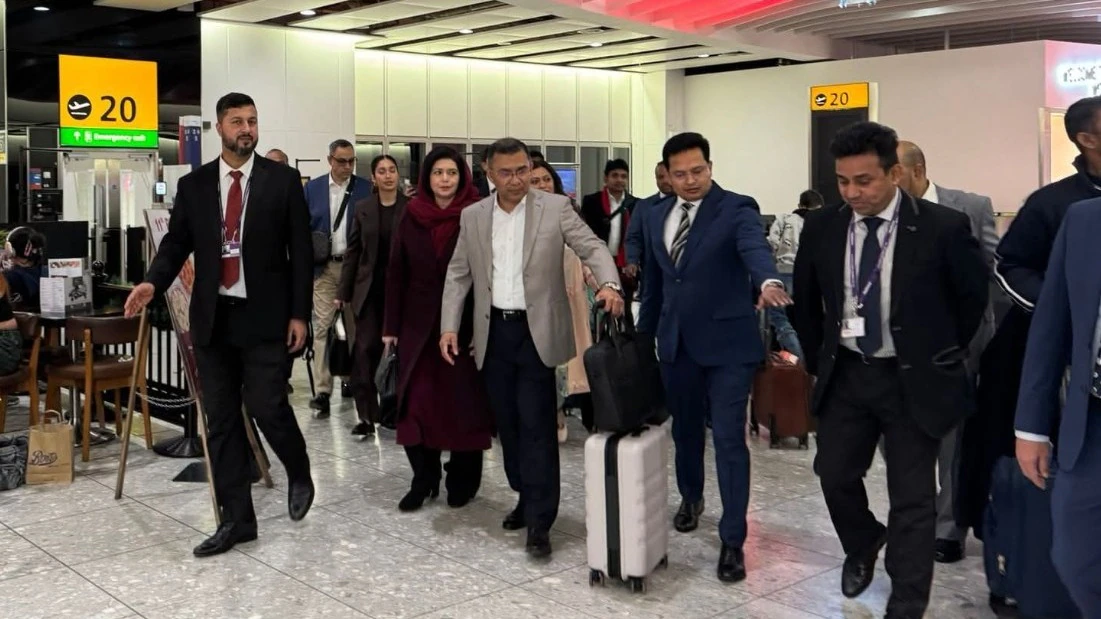
On December 25, 2025, Tarique Rahman — acting chairman of Bangladesh’s main opposition party, the Bangladesh Nationalist Party (BNP) — stepped back onto Bangladeshi soil after 17 years in self-imposed exile in the United Kingdom. His arrival in Dhaka has instantly become a political flashpoint, unfolding against a backdrop of deep unrest, deadly violence, and a country gearing up for national elections in early 2026. (Reuters)
This isn’t just the return of a long-absent political heir; it is a moment of potential reconfiguration in Bangladesh’s political landscape — one with implications not just for domestic politics but for regional stability, governance norms, and democratic credibility.
What This Actually Means
1. A Strategic Re-Entry at a Crucial Political Crossroads
Rahman’s return comes just months before parliamentary elections scheduled for February 12, 2026, making his timing highly strategic. After nearly two decades of exile — originally triggered by legal troubles and political pressure during the 2008 military-backed period — Rahman arrives with his convictions reversed and his political capital largely intact. (Reuters)
For the BNP, his presence transforms an otherwise fragmented campaign into a more cohesive force capable of mobilizing supporters nationwide. Rahman is widely seen as the party’s top prime ministerial contender in the upcoming polls. (www.ndtv.com)
2. An Opposition Force Reinforced — at a Time of Deep Instability
Bangladesh is not in a political lull. Tensions have soared following the death of student leader Sharif Osman Hadi, whose killing sparked widespread protests and renewed suspicions about political violence linked to state and non-state actors. (The Times of India)
Amid this friction, a crude bomb explosion in central Dhaka killed a young man, underscoring how volatile the situation remains. (Hindustan Times)
Rahman’s return, therefore, is not merely symbolic — it is arriving in the eye of a storm of anger, protest and distrust toward the interim authorities.
3. A Shift in Power Dynamics
The interim government, led by Nobel laureate Muhammad Yunus after the ouster of long-time prime minister Sheikh Hasina in a student-led uprising, currently governs the country. (France 24)
With Hasina’s political apparatus weakened — including the Awami League’s ban from electoral participation — and the BNP energized, Bangladesh is heading into an election where the traditional balance of power could be fundamentally altered. (Hindustan Times)
This is not simply a change of faces but a structural rebalancing of political factions that have competed — often violently — for decades.
Why You Should Care
1. Regional Stability at Stake
Bangladesh is Bangladesh — but its stability matters beyond its borders. It shares economic, cultural, and security ties with India, Myanmar, and the broader South Asian region. A rapid escalation of unrest — especially around elections — could reverberate across borders, affecting markets, migration patterns, and diplomatic relations. Already, protests in India over communal violence in Bangladesh have strained ties. (Hindustan Times)
Further, Bangladesh’s vital role in regional supply chains and its proximity to the Bay of Bengal give its domestic politics outsized importance for trade and geopolitical alignments between China, India, and ASEAN partners.
2. A Test for Democratic Norms
Bangladesh’s democratic trajectory has been uneven — alternating between military influence, strongman politics, and popular uprisings. Rahman’s long absence and dramatic return make 2026 a referendum on whether institutional politics or street movements will shape the nation’s future.
The specter of violence — from protests, bombings or state crackdowns — means that the outcome won’t just be numbers on a ballot paper. It will be a measure of how competitive, inclusive, and peaceful Bangladeshi democracy has become.
3. Human Impact Beyond Headlines
This unfolding crisis isn’t abstract. Ordinary citizens — like the young man killed in Dhaka — are becoming casualties of a political struggle too often driven by elites. The death of Sharif Osman Hadi, visceral protests, and public expressions of grief reveal a generation ready to challenge entrenched power structures — and not merely through periodic elections. (The Times of India)
Their voices and futures hang in the balance.
What Other Sites Are Missing
1. The Deeper Generational Divide
Media coverage rightly highlights Rahman’s return and the bomb blast, but fewer outlets have explored how Bangladesh’s youth — many born after Rahman left — perceive his comeback. This generation has distinct expectations of governance, economic opportunity, and civic space, shaped by global connectivity and domestic frustrations.
Their reception of Rahman could differ sharply from older BNP loyalists, introducing new fault lines into the election narrative.
2. The Stakes of Legitimacy, Not Just Leadership
Rahman’s re-entry is often framed simply as a “political homecoming.” But it also raises fundamental questions about legal legitimacy: What does it mean when someone re-enters public life after convictions and exiles tied to past political conflict? How will courts, the press, and civil society arbitrate these questions in the coming months?
This isn’t a rerun of old politics; it’s a redefinition of political legitimacy in Bangladesh.
3. The Broader Social Contract
Beyond BNP vs. Awami League, Bangladesh’s crisis speaks to the fragility of its social contract. Protests erupting over minority killings, youth deprivation, and political exclusion reflect deeper anxieties about justice, equality, and national identity.
Few analyses connect these socio-political threads into a coherent narrative — yet this is precisely where Bangladesh’s long-term trajectory will be decided.
Looking Ahead: What Comes Next
- Elections in February 2026 will be a watershed. Whether they are free, fair, and peaceful will determine if Bangladesh stabilizes or continues on a tumultuous path.
- Rahman’s leadership — if he secures power — could redefine Bangladesh’s alignment with regional powers, domestic media freedom, and economic policy.
- Youth and civil movements may become kingmakers or spoilers, especially if they feel excluded from mainstream party politics.
- International pressure — especially from democratic partners — could shape how the interim government manages dissent and transitions authority.
In sum: what appears as a dramatic return of a political heir is far more than that — it is the opening chapter in Bangladesh’s next political epoch — a struggle over legitimacy, power, and the soul of its democracy.